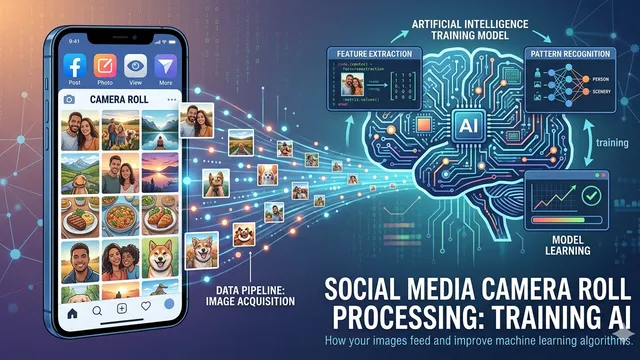
A recent application update has drawn attention to a Facebook feature called Camera Roll Cloud Processing. When active, this setting allows the app to scan your device’s local photos and videos, sending them to Meta's servers for analysis by Artificial Intelligence(AI). The stated purpose of this action is to enhance user experience by means of generating layout suggestions, collages, and notifications. If opted in, the installed application uploads all content on the device, not just what the user has chosen to upload to the platform.
By understanding how these systems operate, individuals can make informed decisions about their digital footprints. You should decide exactly when, and if, your personal media could serve as fuel for machine learning.
Some users ask why AI systems seek to extract information on an ongoing basis, rather than relying on a series of one-time uploads. For the development of artificial intelligence, a static database is like a single textbook, whereas a consistent data stream is an education. There are three main reasons why AI models rely on continuous pipelines of real-world data.
The human world is constantly changing. Trends shift, consumer products improve, landscapes are rebuilt, and even the ways people frame photos change over time. If an AI model is trained only on a fixed, historic snapshot of data, its accuracy will steadily degrade. This phenomenon is known as model drift. A continuous data stream can act as a calibration tool, keeping the outputs relevant.
In addition, Artificial Intelligence cannot truly understand a user or a population by looking at isolated variables. By processing a continuous stream of images, timestamps, and metadata, machine learning models learn to recognize temporal patterns. It observes how families age, how seasons change, how lifestyle habits evolve, and what environments people are living in. This contextual data allows algorithms to significantly improve their predictive capabilities. This faculty can be applied to various applications, from targeting advertising to automating content creation.
Finally, It is relatively easy to train an AI to recognize a dog using thousands of clean, professional stock photos. However, training an AI to recognize objects in the real world requires "noisy" data. Candid camera roll photos, which could be out of focus, poorly lit, unusually composed, or marred by a busy background, provide chaotic, diverse raw material. This type of matter is ideal for neural networks that underlie AI to improve facial recognition, object detection, and spatial awareness.
The default setting for the updated Facebook app is that Camera Roll Cloud Processing is on for all users. Here is how to turn this feature off on an iPhone, keeping in mind that this procedure will vary depending on the operating system.
FIRST: Open the Facebook app and tap Menu.
SECOND: Select the Settings gear on the upper right.
THIRD: Scroll down and pick Camera Roll Sharing Suggestions.
FOURTH: Toggle off Camera Roll Cloud Processing.
Android users who have decided to decline having their local media files parsed by background Meta algorithms have two layers to manage. Both the Facebook app settings and the Android operating system permissions must be adjusted. The procedure is essentially similar for controlling the component in the Facebook app. Once that is complete, users must also navigate to Permissions in their system Settings, select the Facebook application, and then limit access to photos.
It must be said that it is not necessarily harmful to allow commercial enterprises to train these systems in this manner, and there is the potential for substantive benefit. This author is of the opinion that individual users should be compensated for providing these raw materials, however we suspect that argument is moot.
At this stage, the recommendation remains to be aware that these platforms are not free, even though they can be used at no cost. There is an exchange for something of value, and the end user must be intentional about what inputs they provide.