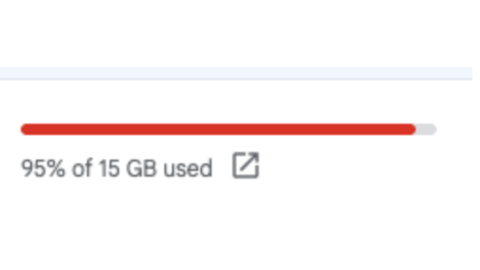
Have you, or someone you know, been receiving communications that email access may be lost due to lack of storage ? Check these carefully, because if the notices are coming from a legitimate provider they are not an attempt to defraud. Free email service typically comes with a defined amount of space for managing attachments and the archive of ongoing messages. Once this is full, end users are expected to either delete items to make space or sign up for a paid service plan.
Why deal with this now ? The four seasons each have developed meanings that are traditionally associated with that time of year. Spring is often associated with an annual cleaning ritual. In fact, clearing out clutter is likely to be a good idea any time of year. This is especially true when it comes to managing digital clutter.
However, where exactly is this overflow? It is in “The Cloud”, a term which refers to various types of online storage capacity. Computers connected to the internet at diverse locations all over the world are providing an information repository as a business opportunity.
The advantage of this type of system for consumers is that users can access their property anywhere that an internet connection is available. Any one of a broad range of capable devices can be used, depending on preference. By and large, the businesses that furnish these services utilize a business model that provides a basic amount of space at no charge. During ongoing use that capacity is gradually absorbed. Once the allocation is exhausted, the customer must pay for more.
There is nothing improper about this. Promotional sampling is an accepted and established marketing technique. Returning to the example of electronic mail service, correspondence accumulates over time. A stockpile of attachments piles up. This material is available for retrieval, so it has to exist somewhere. That space in its entirety is referred to as The Cloud. Distinct private enterprises offer different terms and features in their versions of this utility.
For example, a Gmail account comes with 15 gigabytes (GB) of storage. When logged in, users can observe how much of this capacity is engaged at the lower left of the interface. It is a fact that once the 15GB is consumed that the service will no longer send or receive anything. The service provider does reach out via their platform to alert their customers about this aspect. This is not spam. Periodically cleaning house is sound practice, and not just in the Spring.
This issue exists across platforms. Apple provides 5 GB with its iCloud, and Microsoft furnishes the same with OneDrive. End users who prefer these tools will see reminders about running out more frequently. No matter the device, here is a three pronged strategy to manage your Cloud systematically.
The first step is to determine which user is using the most, if there are more than one. Follow this with seeing what type of material is being stored. This initial inventory can be built into personal guidelines about what might not be needed versus what is critical. Extraneous matter can simply be deleted. Google has developed an application to manage usage across the tools in its Workspace. The Google 1 utensil can sort files several different ways, including by size. Use this to find the space hogs.
Video clips are files that can often be very large. Find and delete what you no longer need. Look for multiple copies of files as well, such as back ups for old devices. For example, all of the information that was on your old phone may be there, and so are all of the files on your new one. It is likely that you transferred everything to your new from the old when you got it. Doublecheck that, and then delete the oldest back up if possible. This action can at least provide breathing room, preventing an interruption of service.
As a second step, consider using file formats that compress data. In addition, almost every installed application has an option to decline synchronization to the Cloud. Both of these tactics can reduce the volume of your data footprint in the future. Using high efficiency or low resolution formats can have drawbacks however. You definitely should keep that photo that you took from the mountain top at sunrise in full resolution. Once compressed it cannot be restored to its original glory. Similarly, declining service for some applications saves space, but then you don’t ever get that data back when your phone gets dropped on a gravel road. Reducing scope of Cloud service may mean that the end user has to accept the consequences of any mishap.
Finally, it may be worthwhile to consider moving materials that will be permanently retained to an offline system over which the consumer has direct control. The most important files can be retained in the Cloud as well, to protect against any failure of local equipment. Redundant arrays are a common hardware solution, although something as simple as a few flash drives might be all that is needed. Conventional hard drives (HDD) cost less and can offer greater capacity, but their mechanical components will eventually fail. Solid state drives (SSD) are smaller and more costly, but have no mechanical components. Despite this, SSD failure can happen. Storage devices of all types are also getting more expensive due to increasing demand. Users must recognize that data storage at home is not actually free. There are real costs and genuine risks involved.
Cloud storage consumers can consider these three main strategies, delete, reduce and transfer, when implementing a solution. In cases where there are multiple users, family members can sometimes share resources with each other to help. Of course, opening a new free account and starting from scratch works too. Unfortunately, it seems that everyone already has enough things to keep track of these days, so yet another login and password might not bring joy.
Keep in mind that there will be cases when the best remedy is to simply make arrangements for a paid service plan with your preferred provider. There can be tangible value in digital assets such as email threads or photography archives, and peace of mind has value as well..